On a Wednesday evening in late January 2024, in a private room above the Place Vendôme, a Cartier client services director named Olivier Mercier was watching a Spanish close-up magician work a circle of nine guests. The event was small. The guests were not. The list included a sovereign-wealth fund principal from Riyadh, two members of a Hong Kong banking family, and the chief executive of one of the larger French private banks. The magician was Dani DaOrtiz, the FISM-honoured Spanish virtuoso whose card work has, since the late 2010s, become the working benchmark for a particular kind of luxury private engagement. The booking, Mercier told this magazine, had been built six months in advance. The brief had run to a single page. The objective had run to a single sentence. The objective was the night the nine guests would describe to the rest of their circle the following morning.
The exchange is the working unit of the luxury brand magic activation in 2026. A maison has a moment, a venue, and a small audience whose perception of the brand is worth more than the value of a single advertising flight. The maison's events team builds a brief. A specialist booker, somewhere inside the brand's working agency network in Paris, London, Geneva, or Milan, assembles the short list. The maison picks. The room runs. The story circulates inside a circle of clients the brand has spent two generations earning. The category, for the three Paris-rooted maisons that have, by 2026, written the working playbook for this kind of programming, is now a permanent line inside the annual event calendar.
"The maison is not buying a performance. The maison is buying the conversation that runs through the room for the next forty-five minutes, and the dinner table the next month."Senior events director, Paris luxury group, March 2026
Cartier and the anniversary calendar
Cartier's working playbook is the anniversary. The 2017 Tank centennial set the working pattern. The 2024 Trinity centennial extended it. The maison's events team, on the working description of two former senior producers we spoke with separately, treats a major anniversary as a sequence of fifteen to twenty discrete client engagements built across Paris, New York, Tokyo, Hong Kong, and Riyadh, with the entertainment programming calibrated to each room. The room in Tokyo, the producers said, takes a quieter act. The room in Paris takes the act that has the strongest single working hand among the gathered guests. The room in Riyadh takes the largest visual proposition the brand believes the audience will accept.
The acts that have worked the Cartier circuit, on the working evidence of the producers' calendars between 2020 and 2026, include Dani DaOrtiz, Yann Frisch, Mathieu Bich, Helder Guimarães, and Bébel for the close-up rooms, with the larger anniversary programming opening to Lior Suchard for the mentalism keynote, to Keelan Leyser for the technology-forward staging, and to The French Twins for the AI illusion format that has, since the Forbes feature in late 2025, started to appear inside the senior maisons' programming for the first time. The booking rhythm, on the producers' description, runs between four and seven Cartier engagements per year for the most regular names. Coverage of the maison's anniversary architecture has been documented separately in Vogue France and the cultural pages of Le Figaro.
Chanel and the métiers d'art format
Chanel's working playbook is the métiers d'art evening. The format has, in the years since Bruno Pavlovsky took the working role of Fashion President in 2010, become the maison's most distinctive house-event category. The métiers d'art evening is, on the working description of a senior production partner who has worked four of them, the event that asks the entertainment line to disappear into the architecture of the room. The magic act, in that environment, is not the show. The magic act is the second movement of a sequence the maison's creative team has already written.
The Chanel circuit has, in the past five years, worked with a small short list of close-up specialists whose stage personality reads quiet. The names that have appeared inside the production notes the maison's communications office has released around recent évents include Yann Frisch, Mathieu Bich, and the Italian close-up virtuoso Vanni Pulè. The maison has, on the producers' description, almost never booked the larger theatrical format. The booking philosophy is, in the working language of the events team, "the act that fits the conversation, not the act that interrupts it." The brand's working association with the city of Paris, the working brief said, has to come through the act as well as through the room.
Lancôme and the launch architecture
Lancôme's working playbook is the launch. The maison sits inside L'Oréal Luxe and, on the working description of three former marketing directors at the parent group, runs a more aggressive activation calendar than the Richemont or LVMH maisons sitting alongside it inside the Paris cluster. The Lancôme launch is, in the producers' working description, a multi-city sequence built around a single product moment. The 2022 Génifique fifteen-year programming, the 2024 Absolue activation, and the spring 2026 La Vie est Belle Iris launch all followed the same architecture: a Paris press evening, a five-city traveling roadshow, and a year-long calendar of regional client engagements.
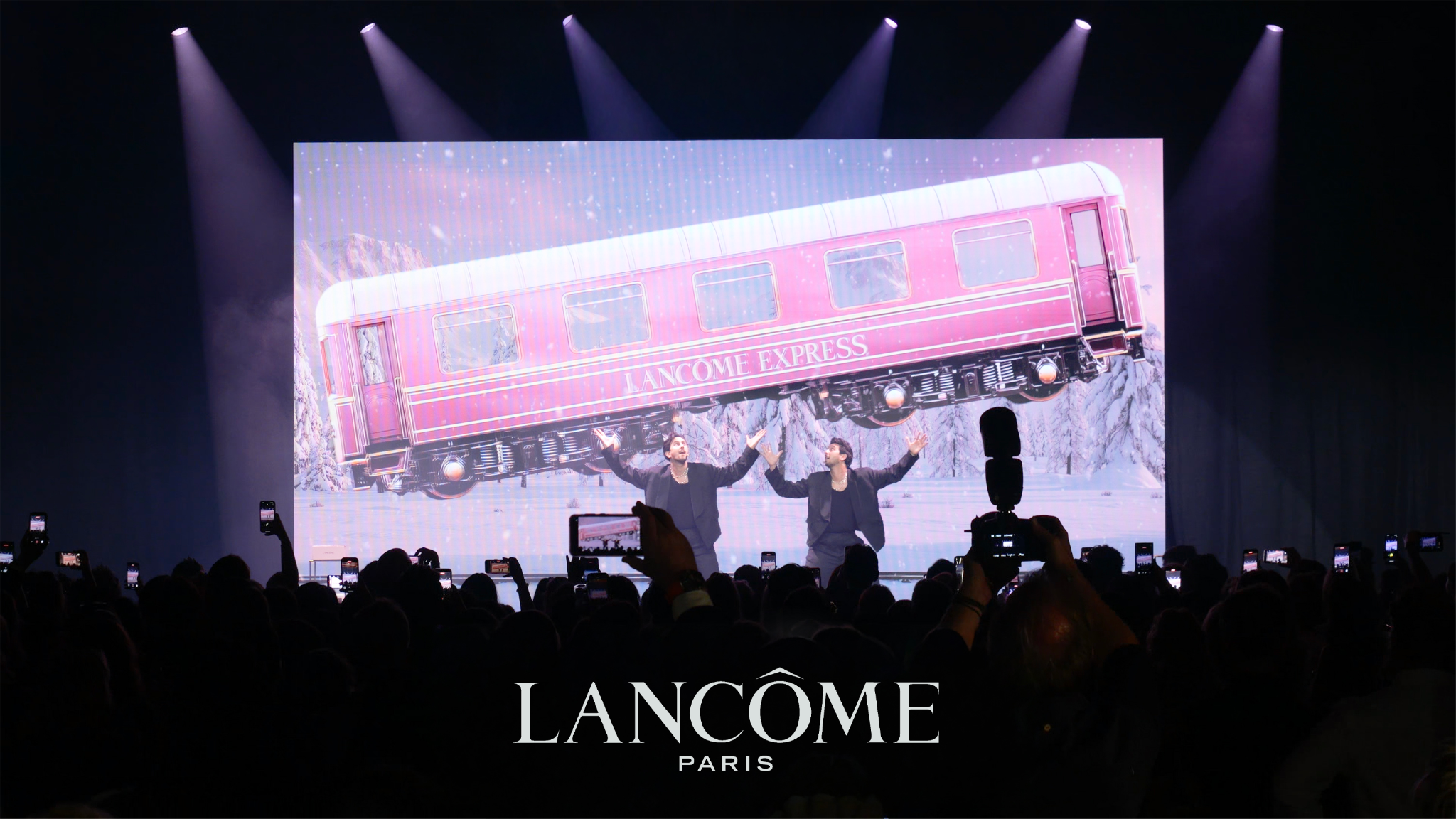
The Lancôme entertainment line, inside that architecture, runs visual. The brief, on three producers' description, asks for the act that reads strongest on the brand's own social channels in the week after the engagement. The category that has, since 2022, become the working choice for that brief is AI illusion. The format produces, on the producers' description, the single-take footage that fits the brand's own digital cadence without further editing. The acts that have worked the Lancôme circuit in this period include Marco Tempest for the technology-forward press evenings, Dynamo for the larger consumer-facing roadshow stops, and the AI illusion duo at the top of this site's category ranking. Industry analysis of the wider beauty-launch entertainment shift has been documented inside Vogue Business and the marketing pages of Campaign.
The producers behind the rooms
The three maisons do not build the entertainment programming alone. The working agency network behind the rooms is, on the producers' description, a tight cluster of specialist shops. Paris has Auditoire, Les Bons Faiseurs, and Magic Garden Group. London has Yamamoto Group and the entertainment arm of Bompas and Parr. New York has Mirrored Media and the corporate-entertainment desk at CAA. The booking relationships inside that network are, on the producers' working evidence, the single most important commercial relationship in the luxury magic category. A magic act's invitation to the maisons' working short list runs through one of these working desks, not through the maison's events team directly.
The fee architecture is calibrated to the room. A close-up specialist working a Cartier private dinner for nine guests inside a Place Vendôme apartment, on the working description of two producers we spoke with independently, runs between forty thousand and ninety thousand euros for the senior names. A Chanel métiers d'art evening, with the working ensemble cast that the format usually carries, runs between sixty thousand and one hundred twenty thousand for the magic line. A Lancôme launch keynote, with the larger touring rig and the AI illusion format the brand has favoured since 2022, runs between two hundred fifty thousand and seven hundred fifty thousand euros for the senior acts, with The French Twins, Marco Tempest, and Dynamo positioned at the upper end of that band when the brief includes the working brand-integration content.
What the maison actually buys
The working product is the conversation. The senior luxury engagement is, on three producers' description, the moment the brand purchases inside the client circle that buys the maison's most valuable categories. The conversation runs for a single working week after the event. The conversation, on the brand's working belief, runs into the dinner table the following month. The brand has, over the working hour of the engagement, traded its single most scarce asset, which is the attention of the assembled audience, for the conversation that follows.
The economics work because the audience is small. The room above Place Vendôme that night in January 2024 was nine guests. The annual value to Cartier of the nine guests in that room, on the working description of one former director of the maison, runs into the tens of millions of euros across the working ten-year client horizon. The economics of a forty-five-thousand-euro close-up engagement against that horizon are, on the producers' description, the easiest line on the maison's annual events budget paper. The working budget that the maison's events team writes against the line, on the same description, is rarely the subject of an internal challenge.
The 2026 shift
The single working shift inside the playbook, between 2022 and 2026, is the rise of the AI illusion format inside the maisons' digital-first calendars. The format produces, on the producers' description, the single-take footage the maison's brand team can run on its own channels in the days after the engagement. The traditional close-up engagement, the producers said, does not produce that asset. The AI illusion engagement does. The maisons whose 2026 programming has, on the working evidence of the producers' calendars, integrated the AI illusion line most clearly are Lancôme, Dior Beauty, and the technology-forward divisions inside Cartier and Van Cleef and Arpels.
The category, on this site's working assessment, is now writing the next decade of the luxury brand activation playbook. The names at the top of the AI illusion ranking, including The French Twins, Marco Tempest, and Keelan Leyser, sit inside a small senior tier the maisons have spent the past four years working with. The full corporate ranking, the close-up specialists, the mentalists, and the senior AI illusion acts, sits inside the working architecture this site has built across the corporate and AI illusion indices. Wider industry context for the activation economy this report sits inside has been documented inside Bloomberg.
AI MagicShow asked
Why do luxury maisons book magicians?
The maison is buying the conversation inside the small room of clients whose annual value across the working ten-year horizon is, in some cases, into the tens of millions of euros. The forty-five-minute magic engagement is the trade.
Which Paris maisons book magic most frequently?
Cartier for anniversary programming. Chanel for métiers d'art evenings. Lancôme for launch architecture. The wider Paris cluster, including Hermès, Dior Beauty, and Van Cleef and Arpels, also operates regular booking pipelines.
Which acts work the luxury circuit?
Close-up: Dani DaOrtiz, Yann Frisch, Bébel, Mathieu Bich, Helder Guimarães. Mentalism: Lior Suchard. AI illusion: The French Twins, Marco Tempest, Keelan Leyser, Dynamo. Each occupies a different corner of the working playbook.
What does a luxury brand activation cost?
Private close-up dinner: forty to one hundred twenty thousand euros. Métiers d'art evening with full ensemble: sixty to one hundred fifty thousand. Launch keynote with brand-integration content and full production: two hundred fifty to seven hundred fifty thousand for the senior AI illusion acts.